
As Rosh Hashanah approaches and we start planning the holiday menu, apples and honey are high on the list. But Rosh Hashanah isn’t the only time apples get the spotlight. There are plenty of other moments throughout the Jewish year when we enjoy and make use of this natural treat. Read on for a list of things Jews do with this sweet, crunchy fruit and other facts about apples in Judaism.
1. Rosh Hashanah: Dip Them Into Honey
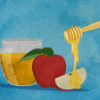
When you think “apples in Judaism,” this is probably the first thing that comes to mind: On the first night of Rosh Hashanah, it’s customary to eat an apple dipped in honey.1 This happens right at the start of the meal, after reciting Kiddush, washing our hands, and eating a piece of challah dipped in honey. Before eating the apple, we recite the blessing of Borei Pri Ha’etz and add a special prayer asking G‑d to bless us with a good and sweet new year.
Read: Why Do We Dip the Apple Into Honey on Rosh Hashanah?
Fun fact: In some Sephardic communities, the apple is dipped not in honey but in sugar!
2. Sukkot: Hang Them in the Sukkah
In many communities (not Chabad), it’s customary to hang fruit from the sechach to decorate the sukkah, and apples are a popular choice. The sukkah of the Belzer Rebbe, Rabbi Aharon Rokeach, would be adorned with multiple apples, which he’d distribute on the Shabbat after the holiday. Other tzaddikim would hang 91(!) apples in their sukkah, the numerical value of sukkah in Hebrew.2
3. Seventh Day of Sukkot: Dip Them Into Honey #2
According to Kabbalah, the judgment of Rosh Hashanah and Yom Kippur is finalized on the seventh day of Sukkot, also known as Hoshanah Rabbah.3 Reflecting the significance of the day, many communities have a custom of staying up the entire night reading portions of Scripture (like Deuteronomy and Psalms). In some communities, as congregants recite Psalms, sweet apples are passed around to be eaten dipped in honey, reminiscent of the first night of Rosh Hashanah.4
4. Simchat Torah: Toss Them to the Crowd
In many Ashkenazi communities, it was once customary to toss apples around the synagogue on Simchat Torah. A similar custom lives on in many Chassidic circles (though again, not in Chabad), where the Rebbe tosses apples to his followers on this day. The chassidim do their best to catch one, and many stories circulate about the blessings and spiritual power an apple like this can carry.5
5. Simchat Torah: Wave Flags with Apples and Candles
Children waving flags on Simchat Torah is a beloved, universal custom. But until the mid-20th century, it had a unique twist: the flag would have an apple on top with a candle stuck inside.
6. Passover: Mix Them Into the Charoset
One of the items on the Seder plate is charoset, a pasty mixture meant to resemble the mortar and brick the Jews toiled with in Egypt. Recipes vary by community and family, but in many homes, crushed or minced apples are one of the primary ingredients.6
7. Shavuot: Toss Them from the Synagogue Roof
When Haman slandered the Jews to King Ahasuerus, he listed off a series of “strange” Jewish customs. One of them was throwing apples from the synagogue roof on Shavuot! Afterward, people would gather the apples from the ground and declare, “Just as we’ve gathered these apples, so may our enemies be gathered from among us.”7
This custom was preserved in certain North African communities. And in some Moroccan communities, grooms would toss apples at their brides on Shavuot (gently, we should hope)!8
8. Medieval France: Throw Them at the Bride and Groom
Here’s a charming wedding custom from medieval France: guests would throw apples at the bride and groom. Why apples? They call to mind a verse in Song of Songs9 describing a mother giving birth beneath an apple tree. There’s also a clever wordplay: the Hebrew words of the verse “Be fruitful and multiply and fill the earth”10 (פרו ורבו ומלאו את הארץ) form the acronym פומא, pomme, French for “apple.”11 (And as it happens, the numeric value of tapuach, the Hebrew word for apple, matches that of pru revu, “be fruitful [and] multiply.”)
Read: 11 Unique Jewish Wedding Traditions From Around the World
9. They Aren’t the Forbidden Fruit
Apples have gotten an unfair reputation, especially in non-Jewish religious art, as the forbidden fruit of Adam and Eve. But while there are various opinions on what that fruit actually was (candidates range from figs to grapes to the etrog, and even to wheat12), it certainly wasn’t an apple. The mix-up seems to trace back to the similarity between the Latin words for “evil” and “apple.”
10. They’re Kosher—Except When They’re Not
Like other fresh fruit, apples don’t require any special kosher certification and can be bought and enjoyed anywhere (after reciting the blessing of Borei Pri Ha’etz). That said, there are exceptions: if you know a particular tree is less than four years old, its fruit may not be eaten due to orlah or neta revai. And if the apple was grown in Israel, you’ll want to make sure it isn’t a product of the shemitah year, and that terumah and maasrot have been properly separated. Preserved apples with added ingredients do need a reliable kosher certification.
11. They’re Mentioned in the Bible
The Hebrew word for “apple,” tapuach, appears several times throughout Scripture.13 Most mentions are in Song of Songs, where it is used metaphorically to describe both G‑d and the Jewish people. Interestingly, some commentators say the Scriptural tapuach is actually the etrog.14 Others, however, maintain it really is the apple.15
Read: 15 Facts About the Etrog
12. Apple-Shaped Designs on the Temple Menorah
The Torah describes the menorah as adorned with cups, flowers, and knobs. What did those knobs actually look like? The Talmud tells us they were shaped like “apples of Crete” (or, in another version, “apples of Beirut”).16 Maimonides adds that these apples were egg-shaped, longer than they were wide, and so were the knobs on the menorah.17
13. An Apple-Shaped Ash Pile on the Altar
The menorah wasn’t the only Temple fixture with an apple shape. Each morning, the priests would rake the ashes on the altar toward its center, forming a large mound the Mishnah calls “the apple,” after its rounded shape.18
Read: The Great Altar
14. Apples in the Garden of Eden
When Jacob entered his father’s tent to receive the blessings, Isaac remarked, “Behold, the fragrance of my son is like the fragrance of a field, which the L‑rd has blessed.”19 The Talmud explains that the fragrance of the Garden of Eden entered the room together with Jacob, and that it smelled like an apple orchard.20 That’s why the kabbalists often call the Garden of Eden Chakal Tapuchin Kadishin, the “Holy Apple Orchard.”
15. G‑d and the Jews Are Compared to Apples
As mentioned above, Scripture compares both G‑d and the Jewish people to the apple tree and its fruit. Here are a few of the connections:
- An apple tree isn’t much of a help when the weather heats up, since it doesn’t offer much shade. Similarly, the other nations refused to sit beneath G‑d’s “shade” and receive the Torah.21
- The tapuach produces its fruit before it grows leaves. Similarly, the Jews declared “We will do G‑d’s commandments” before saying “We will understand them.”22
- Kabbalistic teachings link the apple’s three typical colors—light green, dark green, and red—to the three supernal attributes of kindness, severity, and harmony.23
Read: The Apple Revealed


Start a Discussion